
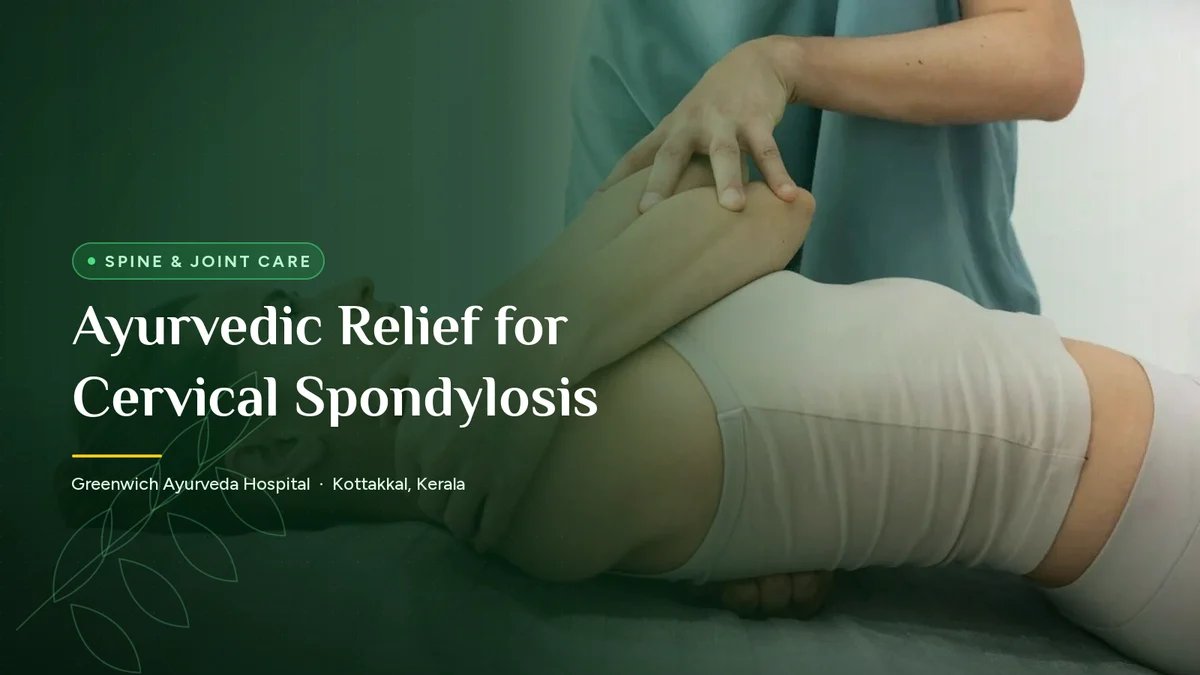
Long hours on laptops, constant phone use, two-wheeler commutes and poor sleep posture have made neck pain one of the most common complaints we see. For many people, the cause is cervical spondylosis, the age-related and strain-related wear of the discs and joints of the neck.
The good news is that most patients respond very well to conservative care. At Greenwich Ayurveda Hospital, Kottakkal, our cervical spondylosis treatment combines classical Kerala therapies with physiotherapy and practical posture correction.
What Is Cervical Spondylosis?
The cervical spine is made of seven vertebrae separated by cushioning discs. Over time, and faster with poor posture, these discs lose water and height, the joints develop small bony outgrowths (osteophytes), and the surrounding ligaments stiffen. When this narrows the space for the nerves or the spinal cord, symptoms spread beyond the neck.
Common Symptoms
- Neck pain and stiffness, often worse in the morning or after long screen time
- Pain spreading to the shoulders and between the shoulder blades
- Headaches starting at the back of the head
- Tingling, numbness or weakness in the arms or fingers
- A grinding or clicking feeling when turning the neck
- Giddiness on sudden neck movements in some people
Red-flag symptoms: see a doctor urgently
Seek prompt medical evaluation if you notice difficulty walking, loss of balance, clumsy hands, progressive arm weakness, or changes in bladder or bowel control. These may indicate spinal cord compression (myelopathy), which needs specialist assessment.
How Ayurveda Understands Neck Pain
Ayurveda describes cervical spondylosis under Greeva Graha (neck stiffness) and Vishwachi (pain radiating along the arm). It is primarily a Vata disorder: Vata’s dry, rough and mobile qualities lead to degeneration of the discs and joints, while blocked channels lead to stiffness. Treatment therefore aims to:
- Lubricate and nourish the tissues
- Relieve muscle spasm and stiffness
- Reduce inflammation where it is present
- Strengthen the supporting muscles and correct posture so the problem does not return
Key Ayurvedic Therapies for Cervical Spondylosis
Greeva Vasti
A ring made from black gram dough is placed around the back of the neck and filled with warm medicated oil, which is kept there for 30 to 45 minutes and gently rewarmed. This focused oil therapy is one of the most effective local treatments for neck stiffness and disc degeneration.
Elakizhi (leaf bolus therapy)
Fresh medicinal leaves are fried with herbs and medicated oil, tied into cotton boluses, and applied warm with rhythmic pressure. It is particularly useful for pain with muscle spasm. Learn more about Elakizhi.
Abhyanga and Swedana
Full-body or upper-body oil massage followed by herbal steam relaxes tight muscles of the neck, shoulders and upper back. See Abhyangam therapy.
Nasya
Medicated nasal drops are traditionally used for disorders above the collarbone, including neck stiffness and associated headaches. See Nasyam treatment.
Njavarakizhi
For chronic cases with muscle wasting or weakness, boluses of medicated Njavara rice help nourish and strengthen the tissues. See Njavarakizhi.
Internal medicines and Vasti
Herbal decoctions, tablets and medicated ghee may be prescribed to support the treatment. In selected cases, a course of Vasti (medicated enema) is added to address Vata at a systemic level.
Why Physiotherapy Matters
Therapies reduce pain; exercise keeps it away. Our physiotherapy team teaches:
- Chin tucks and deep neck flexor strengthening
- Shoulder blade (scapular) stabilisation exercises
- Gentle range-of-motion and stretching routines
- Ergonomic changes for your workstation and sleep position
Everyday Habits That Protect Your Neck
- Raise your screen to eye level. Looking down at a phone can multiply the load on your neck several times.
- Take a movement break every 30 to 40 minutes at work.
- Use a low, supportive pillow. Very high or multiple pillows keep the neck bent all night.
- Avoid sleeping on your stomach, which twists the neck for hours.
- Keep your neck warm. Avoid cold air conditioning blowing directly on your neck, a common trigger for Vata-type stiffness.
- Eat warm, nourishing food and avoid excessive dry, cold or processed foods.
How Long Does Treatment Take?
Mild cases often improve noticeably with 7 to 14 days of therapy plus home exercises. Long-standing cases with nerve symptoms usually benefit from 14 to 21 days. Your physician will advise after examining you and, where available, reviewing your X-ray or MRI.
When Is Surgery Needed?
Most people with cervical spondylosis never need surgery. It is usually considered only when there is progressive nerve or spinal cord compression, severe weakness, or symptoms that do not respond to conservative treatment. If your scans suggest significant compression, we will advise you to consult a spine specialist, and Ayurvedic care can still support your recovery afterwards.
Get Relief That Lasts
If neck pain is affecting your work, sleep or concentration, an assessment is the first step. Book a consultation with our physicians at Greenwich Ayurveda, Kottakkal, to discuss a treatment plan suited to your condition.
This article is for general information and is not a substitute for medical diagnosis or treatment.