
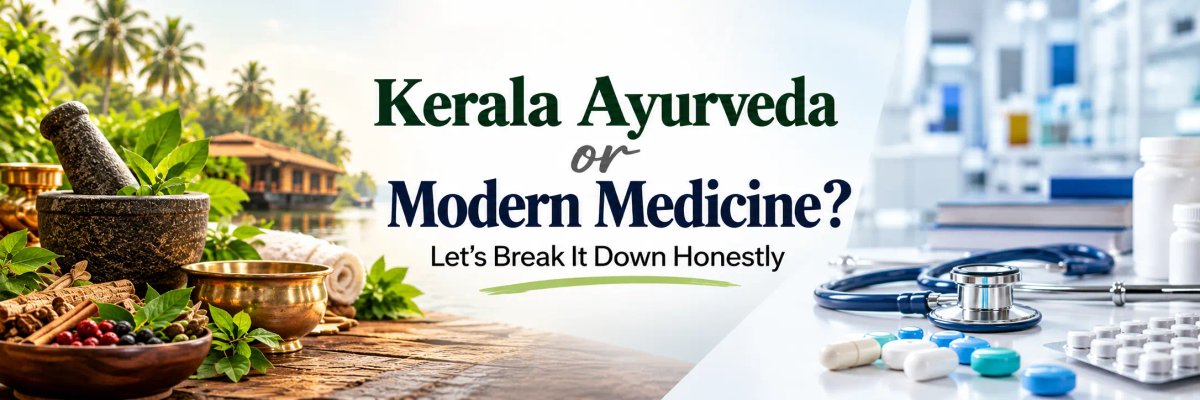
Whenever someone in an Indian household is diagnosed with long-term health trouble—whether it is a bad back, knee pain that won't quit, or a chronic lifestyle issue—the big debate starts almost immediately: Should you go for modern Allopathy, or book a trip for authentic Kerala Ayurveda?
To be fair, it’s a very valid confusion. If you have an emergency, you obviously rush to an allopathic hospital. But at the same time, we have all seen people struggling with joint pain or nerve problems for years, taking pill after pill with little relief, until a few weeks of proper Ayurvedic treatment completely changes things for them.
Living and working in Kottakkal, we see this journey every single day. The truth is, these two systems don't have to fight each other. They do very different things, and once you understand what each is actually good at, deciding what to do becomes much easier.
1. Two Completely Different Ways of Looking at the Body
Let's look at how both approaches think:
- Modern Western Medicine: It views the human body a bit like an intricate machine. If one part is acting up or a virus attacks, doctors give you a targeted medicine to kill the bug, bring down inflammation, or correct a chemical reading. It’s practical, quick, and focuses directly on the trouble spot.
- Kerala Ayurveda: Here, we look at the body as an interconnected system. The idea is simple: your body wants to stay healthy, but daily stress, improper diet, and built-up toxins (Ama) disrupt your natural balance (Vata, Pitta, Kapha). Instead of just suppressing the pain or symptom, Ayurveda tries to fix your digestion, flush out the root toxins, and bring the whole body back into rhythm.
2. How the Doctors Actually Check You
When you visit a modern hospital, it's all about reports and scans. They check your blood work, send you for an MRI or an ultrasound, and look at the numbers. And honestly, thank goodness for modern imaging—it tells you precisely what is happening inside down to the millimeter.
When you walk into an Ayurvedic consultation, things feel noticeably different.
Yes, our doctors also look at your modern scans, but the main assessment starts with you as a person. The doctor will check your pulse (Nadi Pariksha), examine your tongue, look at your eyes, ask about your sleep quality, your bowel movements, your food cravings, and even how stressed you feel at work.
They are basically trying to understand your natural body type (Prakriti) and find out where your system slipped off balance.
3. What Makes Kerala’s Tradition So Special?
You might wonder why people travel from all over the world specifically to Kerala—and Kottakkal in particular—for Ayurveda.
Ayurveda is ancient throughout India, but Kerala kept the practical, hands-on hospital tradition alive without diluting it. The climate is naturally suited for herbal therapies, and the Western Ghats are right here, providing fresh medicinal plants.
More importantly, it’s about the therapies themselves. Real Kerala treatments aren't just spa sessions; they are intensive medical procedures:
- Pizhichil: Warm, medicated herbal oil poured rhythmically over your body. It sounds relaxing, but it is actually a powerful therapy for stiff joints, muscle wasting, and nerve strength.
- Navara Kizhi: Warm herbal rice pouches dipped in milk and decoctions, massaged over the body to nourish tissues and restore weak muscles.
- Classical Panchakarma: A structured 7 to 21-day detox done under strict medical supervision to clean your system from the inside out.
4. Who Does What Better? Let's Be Realistic
Let’s be honest here: no single system has all the answers, and pretending otherwise isn’t helpful for anyone.
Where modern medicine simply has no substitute:
- Life-threatening emergencies: If someone has a suspected heart attack, severe trauma from a road accident, or sudden appendicitis, modern Allopathy is an absolute lifesaver. You need modern ICUs, immediate surgery, or blood transfusions.
- Severe infections: When there is an acute bacterial infection requiring targeted antibiotics, Western medicine works fast and saves lives.
Where Kerala Ayurveda genuinely shines:
- Spine and joint problems: Slip discs, lumbar spondylosis, neck stiffness, sciatica, and chronic knee pain. We regularly meet patients who were advised immediate surgery, but after three weeks of targeted therapies, their inflammation settles, mobility returns, and they avoid the operation altogether.
- Neurological rehab: Stroke recovery, post-paralysis mobility, and Parkinson's management. When nerves are struggling to wake up, herbal oils and focused therapies make a world of difference.
- Gut and lifestyle troubles: Long-standing IBS, stubborn acidity, chronic fatigue, sleeplessness, and general metabolic burnout.
5. Why Not Combine the Best of Both Worlds?
At Greenwich Ayurveda Hospital here in Kottakkal, we don't believe in forcing people to pick a side. Why should you?
If a patient comes to us with a severe disc issue, we look closely at their MRI scan to understand the structural disc bulge. Then, we use authentic Ayurvedic oils, internal herbs, and detox treatments to bring down nerve swelling and pain. Right alongside that, our in-house physiotherapy team works on gentle posture correction and muscle strengthening so the pain doesn’t return once you head home.
You get the deep, natural healing of classical Ayurveda along with the practical functional benefits of modern physical therapy. It’s balanced, safe, and works so much better for long-term health.
Considering an Ayurvedic Treatment?
If you or an elder at home has been dealing with nagging back pain, joint stiffness, or slow nerve recovery, take some time to explore your options. You don't always have to jump straight into surgery or keep popping painkillers.
Feel free to reach out to us at Greenwich Ayurveda Hospital, Kottakkal, share your recent scans, and have a candid talk with our doctors. Let's see what approach will genuinely work best for your recovery.