You look in the mirror and one side of your face will not move. Your smile is lopsided, your eye won’t close fully, and water dribbles from the corner of your mouth. This sudden facial weakness is very frightening, and the first question is always: is this a stroke?
Often, it is Bell’s palsy, a sudden weakness of the facial nerve. The good news is that many people recover well. At Greenwich Ayurveda Hospital, Kottakkal, we support recovery from facial paralysis with classical Kerala therapies, facial exercises and careful follow-up.
First: Rule Out a Stroke
Sudden facial drooping must always be assessed by a doctor immediately. Remember the warning signs of stroke with BE FAST:
- Balance: sudden loss of balance
- Eyes: sudden vision loss
- Face: drooping on one side
- Arms: weakness or numbness in an arm
- Speech: slurred or confused speech
- Time: call emergency services immediately
A key clue: Bell’s palsy usually affects the whole of one side of the face, including the forehead, whereas a stroke often spares the forehead and may involve the arm, leg or speech. Only a doctor can make this distinction safely. Learn more about our stroke rehabilitation.
What Is Bell’s Palsy?
Bell’s palsy is a sudden weakness or paralysis of the facial nerve (seventh cranial nerve) on one side, usually due to inflammation and swelling of the nerve. It is often linked to viral infections. Symptoms develop over hours to a couple of days and may include:
- Drooping of one side of the face and mouth
- Inability to close one eye fully
- Drooling and difficulty eating or drinking on one side
- Loss of taste on the front of the tongue
- Sensitivity to sound on the affected side
- Pain behind the ear
The first 72 hours matter
Conventional treatment with steroid medicines is most effective when started early, usually within 72 hours. Please see a doctor promptly and follow their advice. Ayurvedic care can be started alongside, or afterwards, to support nerve recovery.
How Ayurveda Understands Facial Paralysis
Classical texts describe facial paralysis as Ardita, one of the major Vata disorders affecting the head and face. Exposure to cold wind, stress, poor sleep, loud speaking and Vata-aggravating habits are mentioned as contributing factors. Treatment aims to pacify Vata in the head and face, nourish the nerve and muscles, and restore movement.
Ayurvedic Treatments for Bell’s Palsy
Nasya (nasal therapy)
Nasya is described as a key treatment for Ardita. Medicated oils such as Ksheerabala are gently instilled into the nostrils after facial massage and steam, to act on the head and facial region. See our Nasyam treatment.
Mukha Abhyanga (facial oil massage)
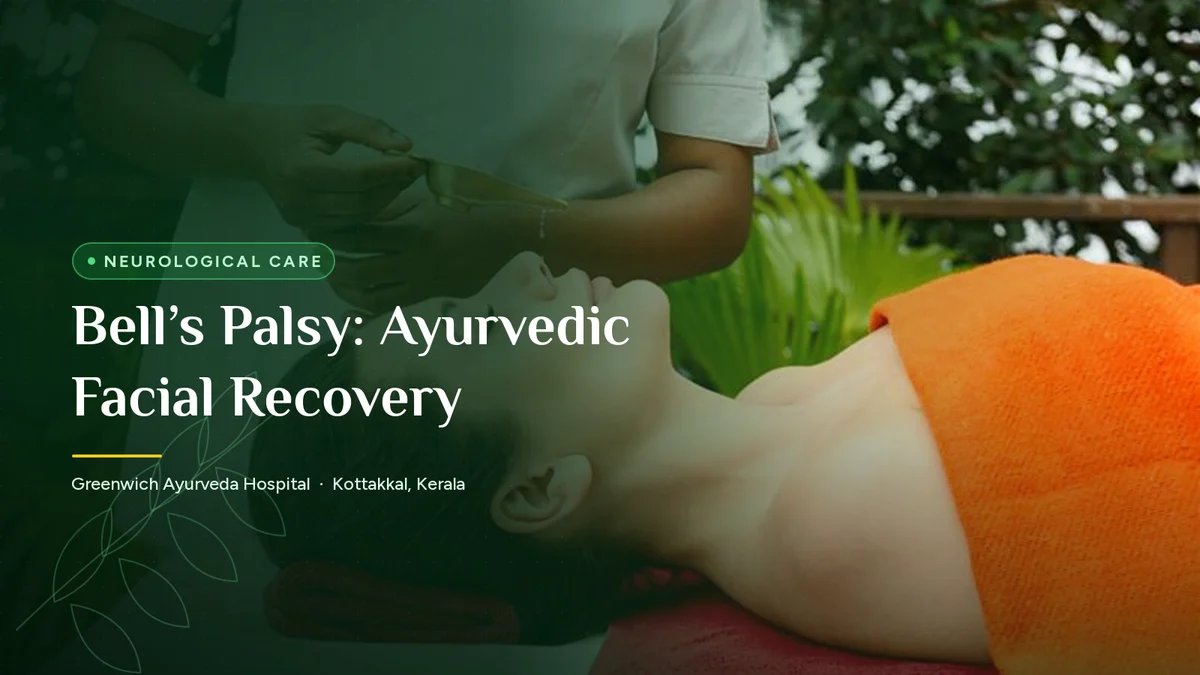
Gentle, upward massage of the face with warm medicated oil stimulates the muscles and improves circulation.
Swedana and Patra Pinda Sweda
Mild steam or small warm leaf boluses (Elakizhi) applied to the face and neck relax tight areas and help reduce stiffness.
Shirodhara and Shirovasti
Head therapies such as Shirodhara and Shirovasti help calm the nervous system, reduce stress and improve sleep, all of which support recovery.
Karnapoorana and Gandusha
Warm medicated oil in the ears (Karnapoorana) and holding medicated liquids in the mouth (Gandusha) are traditional supportive treatments used selectively.
Internal medicines
Classical preparations that support nerve health and pacify Vata may be prescribed by the physician.
Facial Exercises That Support Recovery
As movement begins to return, gentle exercises help retrain the muscles. Practise slowly in front of a mirror, a few times a day:
- Raise your eyebrows and hold for five seconds.
- Close your eyes gently, then tightly.
- Wrinkle your nose.
- Smile with closed lips, then with teeth showing.
- Puff out your cheeks and hold air.
- Pucker your lips as if to whistle.
Avoid forceful, exaggerated movements, which can encourage abnormal muscle patterns (synkinesis). Our physiotherapy team can guide you.
Protect Your Eye
If your eye does not close fully, it can dry out and become damaged. Use lubricating eye drops as prescribed, wear glasses outdoors, and tape the eye closed gently at night if your doctor advises it.
Everyday Care During Recovery
- Avoid cold wind and air conditioning blowing on your face.
- Keep the face and ears warm, especially when travelling.
- Chew on both sides and eat soft, warm food.
- Rest well. Poor sleep and stress slow recovery.
How Long Does Recovery Take?
Many people with Bell’s palsy begin to improve within a few weeks, and a large proportion recover substantially within a few months. Recovery can be slower or incomplete in some cases, particularly when the paralysis is complete at the start or in older adults. Ayurvedic therapy programmes usually last 7 to 14 days, followed by home care and exercises.
Supporting Your Recovery in Kottakkal
Our physicians design individual treatment plans for facial paralysis, combining classical therapies with exercise guidance and close review. Contact us to book a consultation.
This article is for general information only. Sudden facial weakness is a medical emergency until a stroke has been ruled out.